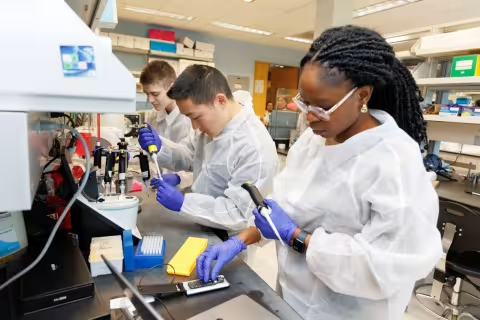





Bacteria Trade DNA to Evolve. Meet the Team Investigating How It’s Done.

By Erin Frick
ALBANY, N.Y. (Nov. 9, 2026) — What if you could get faster just by running next to the speediest person in your jogging group? Or soak up your tutor’s brilliance simply by meeting up at the library, no studying required? (If only, right?) For people, just about any sort of improvement takes real work. For bacteria, it’s a little easier.
Researchers working in Associate Professor Cheryl Andam’s lab in the Department of Biological Sciences at the University at Albany study how bacteria swap DNA with their neighbors to acquire useful traits and grow stronger.
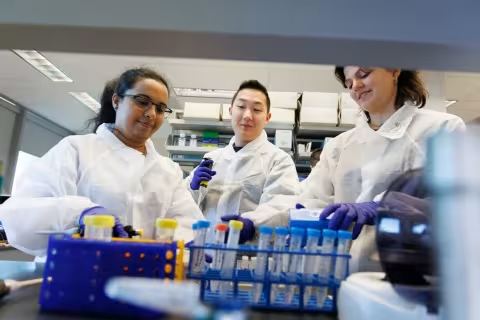
“By analyzing DNA from harmful bacteria like E. coli, staph and ‘zoonoses’ that jump from animals to people (like COVID-19), we are able to trace who’s been swapping genes,” Andam said. “This helps us understand how bacteria are evolving to become drug-resistant, more invasive and better at spreading infection.”
The “swapping” in question happens in three known ways. Some bacteria absorb DNA that enters the environment when nearby cells die. Others exchange DNA by building physical tunnels connecting them with their neighbors. Viruses can also spread DNA among cells as they move from one to another along the chain of infection.
Andam’s team spans undergraduate students to postdoctoral scientists who came to her lab from across the country and the world. Together, their projects are helping untangle how microbes trade genetic information, and what that means for human health.
Meet the Team
Eonson Wong
A senior biology major from Ipoh, Malaysia, Eonson Wong studies bacteria that can cause severe bloodstream infections. He started in the Andam Lab as a volunteer and now works as a research aide.
What got you interested in science?
My mom bought me a little microscope when I was a child, before I even understood much about science. Looking back, I think that helped spark my curiosity about things we cannot see with our eyes.
What’s the number one thing you’ve learned from being in the lab?
The biggest thing I’ve learned is to be patient when solving problems. Research does not always go as expected, and sometimes you have to ask questions, check your work and try again. Being in the lab has helped me become more confident about learning from mistakes and asking for help.
How will your work help people?
Staphylococcus aureus (staph) bacteria can cause serious infections. Understanding staph genes helps us understand why some strains of the bacteria may be more harmful than others. Studying the processes that enable bacteria to acquire new traits like antibiotic resistance can contribute to a better understanding of how bacteria evolve and how infections might be prevented or treated.

Kali Christopher
A second-year biology PhD student from Tulsa, Oklahoma, Kali Christopher is measuring gene exchange among Enterococcus bacteria — a key step toward predicting how they spread antibiotic resistance.
How did you end up pursuing a PhD in biology?
I actually didn’t enjoy science at all until halfway through my first year of undergrad. My first science class of my undergraduate career was called Ecology, Microbiology and Evolution. It was highly focused on the pathways between multicellular and unicellular organisms — in other words, how they interact, why and what that interaction causes.
Prior to that class, I mostly thought of science as just a jumble of facts. Discovering that all of those small facts fit into a huge picture about life and how it works is what made me interested in science. I love the puzzle of it all!
What are you studying and how will it help people?
I’m working with genetic material in Enterococcus bacteria, focusing on quantifying how often Enterococcus genes are exchanged between members of the same species.
Knowing how likely Enterococcus is to exchange genes with its friends will help us predict future changes in the genome. This is especially important for genes that help the bacteria resist antibiotics. We don’t want those genes getting exchanged, but before we can do anything about it, we first need to know how often that occurs. My work will help future scientists come up with ways to combat processes that help bacteria get stronger.
Bryce Chong
A third-year PhD student from Guilderland, New York, Bryce Chong studies how Klebsiella bacteria that cause bloodstream infections become able to resist antiobiotics and grow more virulent.
What are you working on?
My work focuses on bacterial bloodstream infections, one of the most serious infections you can get. I collaborate directly with Dartmouth Hitchcock Medical Center, which provides samples collected from patients with Klebsiella bloodstream infections. This is the real-world application and why our research is important.
Looking closely at the genes that control antibiotic resistance and virulence helps us understand how and why these infections become harder to treat. This information can help doctors choose the right treatment and recognize when resistant bacteria are spreading. Our work directly supports public health surveillance, so hospitals and health agencies can track where resistant and dangerous strains are showing up and respond earlier.
What (if anything) beyond solving major medical questions drives your work?
In undergrad, I was on the premed track, so many of my classes were biology and science related. My identical twin brother attended the same school, and his neuroscience research caught my attention. We soon fell into a friendly, competitive rivalry, which continued through graduate school as we both aspire to attain our PhDs. Watching his dedication in the lab during our early years of undergraduate study showed me what research could be, and that sparked my interest in research as a whole.
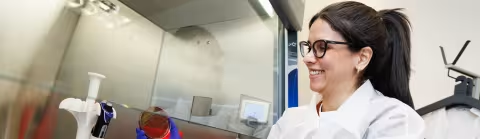
Ana Beatriz Garcez Buiatte
Postdoctoral associate Ana Beatriz Garcez Buiatte is from Uberlândia, Minas Gerais, Brazil. While pursuing her PhD, she spent six months in the Andam Lab working on sequencing Campylobacter samples. That collaboration encouraged her to come back.
Have you always been interested in science?
Yes! I was a very curious child, and although I didn’t know early on that I wanted to be a scientist, that interest grew over the years. I studied veterinary medicine in Brazil and worked in the poultry production industry. During that time, I became fascinated by the programs designed to control specific pathogens and how much effort went into preventing and controlling them to protect public health. That experience left me with so many questions about each pathogen, and here I am!
What’s your main research question?
My goal is to understand how pathogens adapt to, spread among and persist in different niches, and why some lineages go on to cause outbreaks, epidemics or even pandemics.
I’m currently working with Staphylococcus aureus superantigens — toxins that overstimulate the immune system by activating an unusually large number of immune cells at once, which can lead to severe conditions such as toxic shock syndrome. My goal is to understand how these genes are affected by recombination and which mechanisms drive their spread across different lineages.
Why do we need to answer this question?
Many bacterial species share the same environments and can move between different hosts, including animals and humans. The pressure to survive and persist in these settings shapes how bacteria behave. One of their most powerful strategies is to reshape their genomes through horizontal gene transfer. This process allows genes that confer adaptive advantages, such as antibiotic resistance and virulence, to move rapidly across strains and even across species, which is a major reason why new, more powerful “lineages” of bacteria can emerge and spread so quickly. Understanding these mechanisms gives us a clearer picture of how traits such as antibiotic resistance and virulence spread.
By comparing bacterial populations at the genomic level, we can also track high-risk lineages, identify where they come from and how they move, and support better surveillance, treatment and prevention strategies in both human and animal health.
The Andam Lab recently received $2 million from the National Institute of General Medical Sciences, part of the National Institutes of Health.